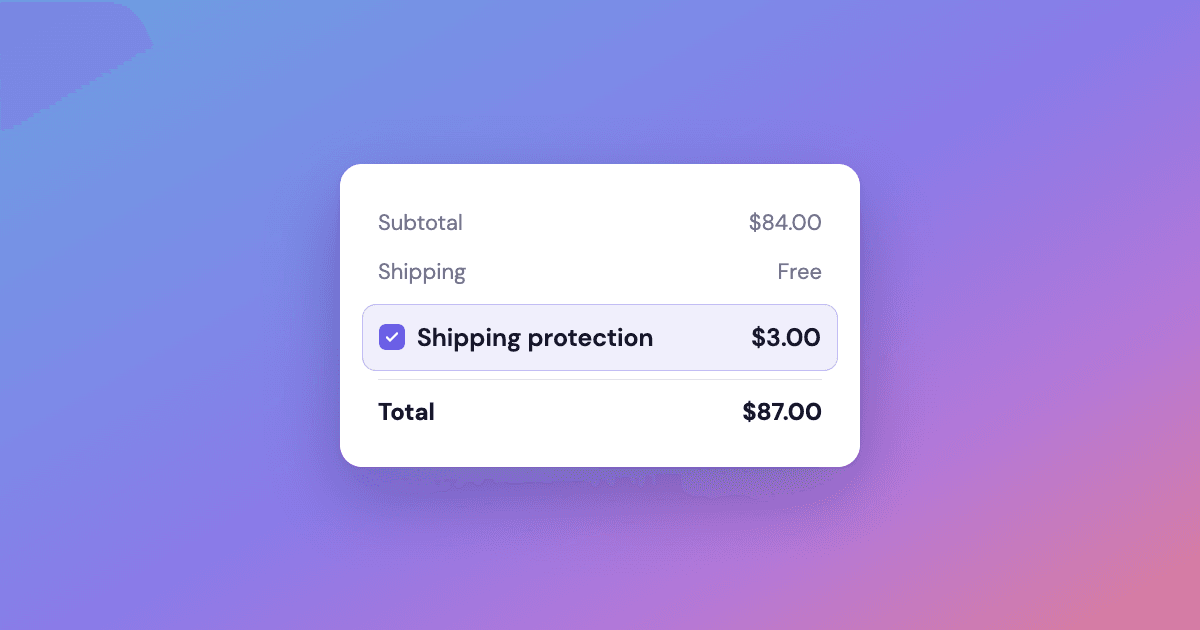
Shipping protection apps that cost "$0 a month" are paid for by your shoppers, and the provider keeps most of that money. For a store doing 1,000 orders a month, that's about $1,665 a month walking out the door. On a flat-fee plan you keep it for $99 a month, though you pay your own claims.
Below I'll go through the numbers for a single store, then add claims back in, since that's where most comparisons get lazy. I'll also cover the cases where revenue share is the better deal.
Where the fee goes
When a shopper adds protection at checkout, they pay a fee on top of their order. What happens to that fee depends on how your app is priced.
With revenue share, the provider takes most or all of it and handles claims. Your bill says $0 because your customers are covering it. With a flat fee, you pay a set monthly price, keep every dollar shoppers pay, and replace lost packages out of that money yourself.
The app's price tag doesn't tell you much. What you want to know is how much of your shoppers' money leaves the business each month.
The math at 1,000 orders a month
Take a store doing 1,000 orders a month with a $3 protection fee. In our merchants' best month so far, 74% of shoppers opted in. At that rate, 740 orders are protected and the store collects $2,220 a month.
If the provider keeps 75%, it takes $1,665 of that, which comes to about $20,000 a year. Put another way, $2.25 of every $3 your shoppers pay goes to the provider. On our flat fee, which starts at $99 a month, the store keeps the whole $2,220.
That comparison flatters the flat fee, though, because it ignores claims.
Adding claims back in
If you keep the fee, you also pay for the packages that go missing. So the fair way to compare is what you collect, minus claims, minus the plan.
We don't publish claim rates yet, so treat these as placeholder numbers: say 2% of protected orders end in a claim, and each one costs you $40 to replace and reship. That's roughly 15 claims and $592 a month. Swap in your own figures if you have them.
For a sense of scale, about 0.45% of US package deliveries were stolen in 2025, or one in every 228, according to Capital One Shopping's package theft research (updated June 2026). Theft is only one kind of claim, next to lost and damaged packages, so we used 2%, more than four times the theft rate, to stay on the cautious side.
| Per month, 1,000 orders | Provider keeps 100% | Provider keeps 75% | Flat fee ($99) |
|---|---|---|---|
| Protection fees collected | $2,220 | $2,220 | $2,220 |
| Kept by the provider | $2,220 | $1,665 | $0 |
| Claims you pay | $0 | $0 | $592 |
| Plan cost | $0 | $0 | $99 |
| What you keep | $0 | $555 | $1,529 |
Inputs: 74% opt-in and a $3 fee. The claim rate (2%) and cost per claim ($40) are illustrations.
Even after paying every claim, the flat fee leaves the store about $970 a month ahead of a 75% revenue share.
It still works if you're more cautious about opt-in. At 50%, the store collects $1,500 and spends about $400 on claims. The flat fee leaves $1,001, and a 75% share leaves $375.
You can plug in your own order volume, opt-in rate, and fee on our pricing page.
Why we charge more than some flat-fee apps
We're not the only flat-fee option, and we're not the cheapest. Navidium charges $49.99 a month for up to 1,000 orders (pricing as of Oct 1, 2026), and Shipcheck starts at $9.95 a month (as of Oct 1, 2026). If a protection toggle in your cart is all you need, one of those will save you money.
The difference is in everything around the toggle. Some apps put their own name on the checkout line item by default. Some send customers to the app's own site to file a claim, which is an odd moment to hand them off to another company. And you still need a policy, a claims portal, the "your package is lost" emails, and some way for your support team to approve claims.
Protectly covers all of that under your brand: the cart and checkout extensions, your policy and terms, the claims portal, and the emails. Claims get approved inside Gorgias and kick off Klaviyo flows, and the offer can sit in Rebuy's Smart Cart. Your shoppers never see our name. You can see how the integrations work.
When revenue share makes more sense
A flat fee isn't the right call for everyone.
If you ship a few hundred orders a month, the dollars are small. A 200-order store collects about $444 in fees, and handling claims yourself might not be worth the time it takes.
If you'd rather not carry the risk, revenue share puts a bad month of lost packages on the provider instead of you.
And someone on your team has to look at each claim. It only takes a few minutes in your helpdesk, but if nobody has those minutes, that's a real cost.
If none of that sounds like you, you're paying a provider to carry a risk you could carry yourself.
Run your own numbers
Try your order volume, opt-in rate, and fee in the pricing calculator. If the gap looks worth it, you can start a 14-day free trial. It's billed through Shopify and there's no contract. Or book a call with us and your first month is free.
FAQ
How much does shipping protection cost a Shopify store?
It depends on how the app is priced. Revenue-share apps are $0 a month, but the provider keeps most or all of the fee your shoppers pay. In the 1,000-order example above, that's $1,665 to $2,220 a month. Flat-fee apps run from about $10 a month for a basic cart toggle, or from $99 a month for a fully branded program, and you keep the fees.
Is "free" shipping protection really free?
Not really. Your bill is $0, but your shoppers pay the fee and the provider keeps it. That's the provider's business model.
How do shipping protection apps like Route make money?
From the fee your shoppers pay at checkout. Route describes its pricing as "consumer funded" (checked Oct 1, 2026). Revenue-share providers keep their share of every fee and pay claims out of what they collect, so the more shoppers opt in, the more they earn.
Who pays claims on a flat-fee plan?
You do, out of the fees you collect. That's the trade for keeping all of it. In the example above, claims cost about a quarter of what the store collected. Check your own claim rate before switching.
Is shipping protection worth it for merchants?
Usually, if you keep the fee. In the 1,000-order example, the store collects $2,220 a month and pays about $592 in claims, so the fees cover claims nearly four times over. On revenue share, most of that margin goes to the provider instead.
Can I charge my own shipping protection fee on Shopify?
Yes. Flat-fee apps add a protection option to your cart or checkout, and you choose the price. With Protectly you also set the coverage and who approves claims, and the whole thing runs under your brand.
What opt-in rate should I expect?
It depends on your fee, your average order value, and how the offer looks in your cart. Our merchants' best month so far was 74%. I'd plan around a lower number and then measure your own.